
20 and 21 January 2026
In January, we held
the first training within the CREMULEC project.
For two days, we learned
how we can communicate without words.
We created using:
- music,
- colours, and
- images.
Music Workshop
The music workshop was led by a music therapist.
A music therapist is a person
who helps people through music.
First, we calmed down and
listened to the sounds around us.
When we felt calm,
everyone chose an instrument and
made a sound with it.
Through sound, they showed how they felt.
We collaborated.
We worked in pairs and all together.
In pairs, we learned to:
- listen to another person,
- respond with sound,
- recognise emotions such as joy, anger, or fear.
We used different instruments:
- drums,
- shakers,
- bells.
We had enough time
so that everyone could show
how they were feeling.
We learned:
- that we can show our feelings through music,
- that we can listen to each other.
It was nice.
Music connected us.


LIFE TOOL Exhibition
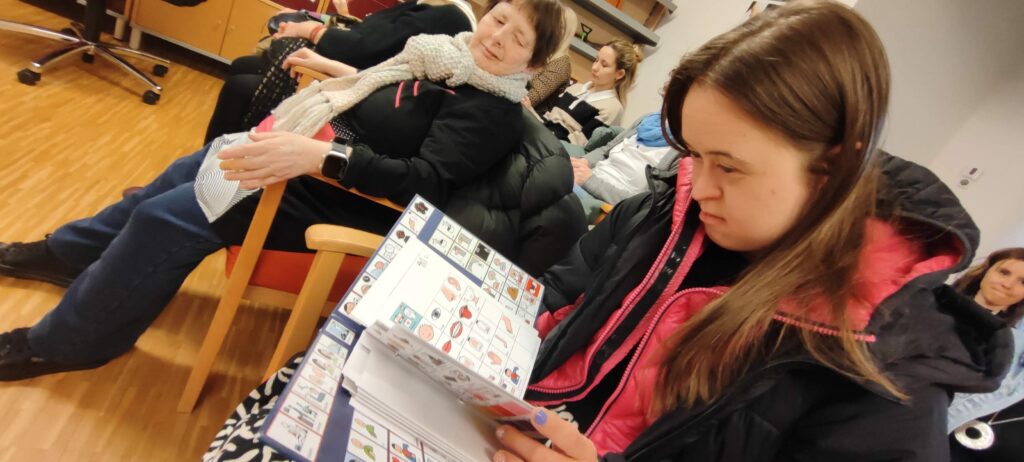
After the music workshop, we visited the Life Tool exhibition.
At the Life Tool exhibition, we saw communication aids.
They are used by people who find it difficult to speak or do not speak.
We learned:
- that there are many ways to communicate,
- that we can communicate even without words.

Art Workshop
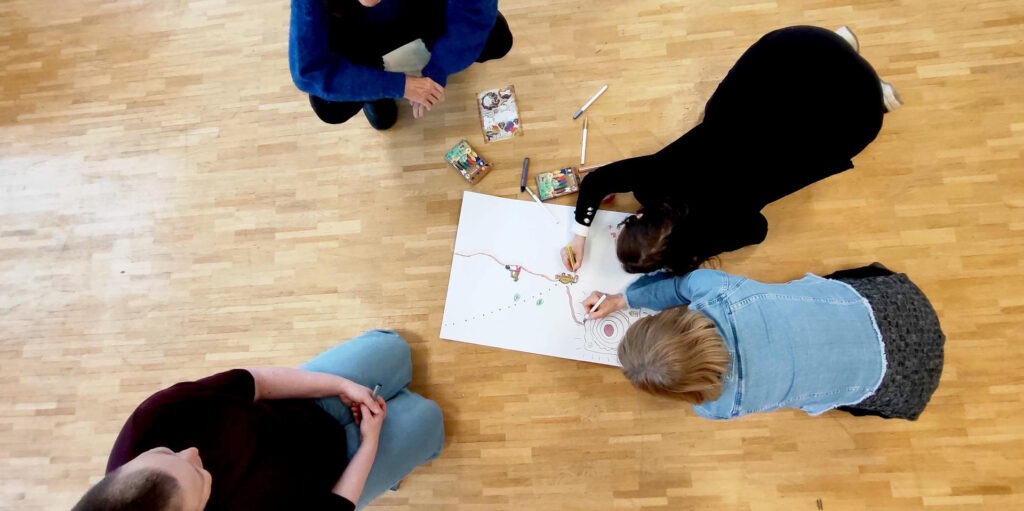
At the art workshop, we drew and painted.
There were no right or wrong drawings.
Everyone could draw whatever they wanted.
Everything was relaxed.
We used:
- marker pens,
- crayons,
- watercolours,
- acrylic paints.
First, we drew freely.
We drew whatever we wanted.
We asked ourselves how we felt while drawing.
We put the drawings on the wall.
We looked at them together.
We talked about our feelings during drawing.
Later, we created a shared artwork.
Everyone drew their own part, and a joint artwork was created.
At the end, we sat in a circle.
Together, we looked at
what we had drawn.
We learned:
- that we can show our feelings with colours,
- that drawing can help us understand other people.
It was nice.
We felt good in the group.
We were together.

Shared Experience
The training in Graz was something special.
Through music, drawing, and creating together,
we learned from one another.
This was the first step of the CREMULEC project.
We will continue learning and creating throughout this year.

Participants Comments
Participant Tjaša:
We had workshops for two days. Creative and music workshops. I thought it was great. It was really nice. I learned through contact with individuals. We played instruments. We had a good time at the training in Graz. We met other people and learned about their experiences in the CREMULEC project.
Participant Nevenka:
It was very interesting in Austria. We had workshops. I got answers and learned many new things. We had a good time.
Participant Ines:
I felt OK at the workshops, even though I am used to working in smaller groups. What stayed with me the most were the music and art workshops and the great energy among all of us. 🙂
I mainly learned that I can also participate in larger groups that, like RISA, understand neuro-inclusivity. 🙂 I already use much of the acquired knowledge in our volunteer workshops at the Plus5 association. I would like to encourage members with different disabilities to contribute their part to the workshops (for example through a game, presenting their main interest or a challenge).
Participant Mateja:
I participated in the workshops in Graz as a volunteer at Zavod Risa and as the mother of a daughter with autism. The whole event impressed me very much. Despite the international group, music and visual expression offered us a universal tool for non-verbal communication that was both effective and enjoyable.
We also visited the LIFEtool centre, which provides counselling on electronic communication options. We saw the latest technology that allows computer control using only eye movement. Besides the interesting programme, I will especially remember the atmosphere of kindness, connection, and friendship that filled both days. What I saw and tried during the workshops will be useful in my everyday communication with my daughter. She often reacts poorly to auditory communication, so for years we have used non-verbal communication, mainly through pictures and gestures, which we can now further develop. Thank you to all participants for the wonderful company and to the organisers for ensuring that the workshops and study visit ran smoothly, that the travel was comfortable, and that our stay in Graz was pleasant.
Participant Katja:
My experience in Graz pleasantly surprised me. I met wonderful people and took part in interesting music and art workshops on how to communicate without words. At first, this seemed impossible to me, but it works. I learned that in a group you can create a kind of story that can start with one person and then be drawn or painted on a large sheet of paper. Looking at everything as a whole, I realised how important communication really is, and I am glad I could participate.
Participant Brina:
The workshops in Graz were extremely interesting, colourful, and at the same time complex, with a deep impact. We had the opportunity to explore how emotions, thoughts, and relationships can be expressed without verbal language, using only sound, rhythm, movement, and visual creation. This approach encouraged greater attention to non-verbal signals and body language. Music is a universal language, just like art. Both dimensions, sound and visual, go beyond words and enable genuine communication even when we do not know the language of the other person or when there are other limitations to verbal expression.
Participant Bojana:
The experience of the entire training in Austria was very valuable. What I liked most was that through music and drawing we practically learned how to express our feelings and recognise the feelings of others through sound, drawings, and colours.
All participants had the opportunity to learn how music and visual creativity can connect us, help us get to know each other, and communicate even without words.
Thank you for the very useful content and the wonderful energy of the whole group.
Participant Hana:
I had an excellent time at the workshops – the atmosphere was warm and stimulating, and the activities were just right. What stayed with me the most was the LiFEtool centre and the communication device using eye-tracking technology. Without patience, this is not possible, and it deepened my respect for every individual who uses it. I realised that we have countless possibilities for communication, looked beyond usual frameworks, and I will use the acquired skills at the first opportunity.
The project is co-funded by the European Union.